Six billion smartphones will eventually have an AI assistant more powerful than OpenClaw is today. Deep, rich personal context will power every one of them. Three weeks ago, a lobster-themed product showed us what that looks like.
OpenClaw, the open-source AI agent created by Austrian developer Peter Steinberger, went from hobby project to over 200,000 stars on GitHub, the developer world's equivalent of a standing ovation from two hundred thousand engineers, in under a month. Apple couldn't keep Mac Minis in stock because developers were buying them as dedicated machines to run it. Cloudflare's stock jumped 14% because OpenClaw uses its infrastructure. And last week, OpenAI hired Steinberger to build their next generation of personal agents.
The hype is real. But the hype isn't the story. The story is what OpenClaw proved about the role of context in AI, and what that means for where personal AI goes from here.
What the Lobster Actually Did
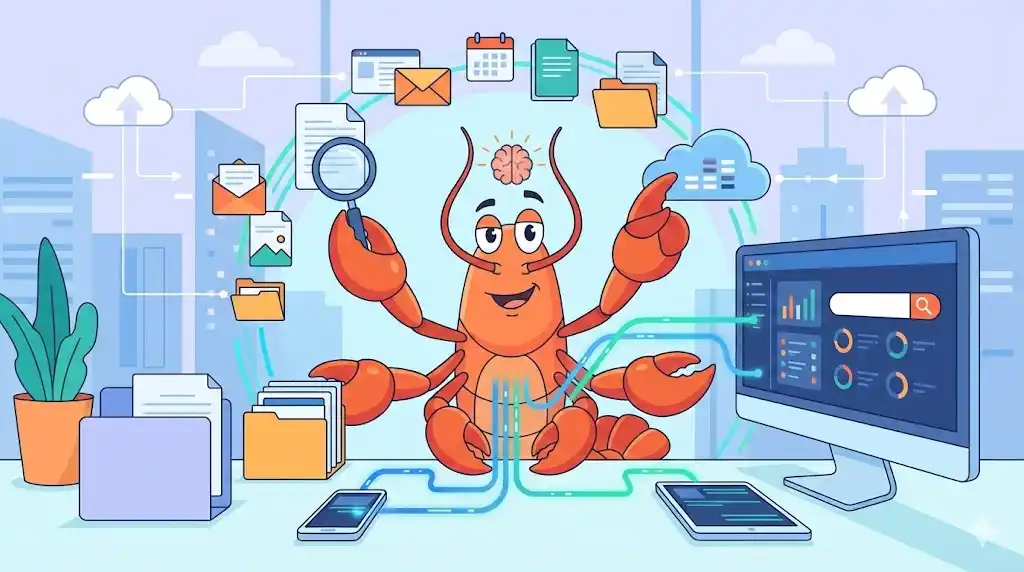
OpenClaw isn't a chatbot. It's an autonomous agent that lives on your computer and has access to everything you have access to. Your files. Your email. Your browser. Your calendar. Your messaging apps. It reads documents, runs scripts, fills out forms, makes phone calls, and executes multi-step workflows without you watching over its shoulder.
That's half the breakthrough. The other half is context.
Because OpenClaw runs locally, it can see your entire digital life. Not the curated snippets you paste into a chat window, but everything: years of files, buried emails, forgotten notes, tax documents from three years ago, that PDF you downloaded once and never opened. It remembers every conversation and, more importantly, understands the meaning behind what you say. Every file on your drive becomes lobster food, nourishment for an AI that gets smarter the more it knows about you.
This is what we've been writing about in this series. In Part 2, we called it the bitter lesson of personal AI: context will always beat intelligence. The assistant with more context will outperform the assistant with less context, regardless of which model is more powerful. OpenClaw just proved it at scale.
Powerful and Terrifying
If it's smart enough, an agent with full access to your computer can do anything you can do. That's what makes it powerful. One user described OpenClaw finding tax documents buried in a downloads folder, cross-referencing them with bank statements in their email, and preparing a summary their accountant needed. Another called it a coworker who sits at your desk with a keyboard and mouse and never sleeps.
The profile OpenClaw builds would make the FBI's top profiler look like a beginner.
But that same access is what makes it a security nightmare. Cisco's AI security team found that third-party plugins could exfiltrate data without users knowing. Researchers discovered exposed installations leaking API keys, chat histories, and system credentials. Palo Alto Networks called it a “lethal trifecta”: access to private data, exposure to untrusted content, and the ability to take real-world actions.
One of OpenClaw's own maintainers put it bluntly: if you can't understand how to run a command line, this project is far too dangerous for you to use safely.
Today, OpenClaw is for developers and power users. Email started the same way, a command-line tool on university networks before it became something your grandmother uses daily. The pattern is always the same: what the tech community builds for itself today, everyone uses tomorrow.
The Context Moat in Reverse
In Part 5 of this series, we described the context moats being built by the big AI labs. OpenAI, Google, and Anthropic are racing to become the default home for your digital memory. The more context they accumulate about you, the harder it becomes to switch to a competitor. That's the play. Not smarter models. Deeper context.
OpenClaw represents the opposite architecture. Your context stays on your hardware. The intelligence comes from API calls to whichever model you choose: Claude, GPT, Gemini, DeepSeek, or a fully local model that never touches the internet. The AI labs serve the tokens. You keep the memory.
This is exactly why OpenAI hired Steinberger. Sam Altman said it directly: this will become core to our product offerings. When the person who just showed the world how to bypass your context moat is available, you hire them. The question every OpenClaw user should be asking: will the context stay at the edge once OpenAI is driving the roadmap?
What OpenClaw Can't See
For all its power, OpenClaw has a significant blind spot. It can access anything stored locally, including things you've forgotten or signals buried too deep in noise for a human to find. But anything behind a login on a remote server is mostly out of reach. Your Netflix watch history, your Amazon purchase data, your airline loyalty profile, your health records in a patient portal. The richest lobster food sits inside walled gardens that OpenClaw can't reliably access.
Even the local context comes with a curation problem. Your computer is full of contradictory information. Old resumes that don't reflect your current career. Bookmarked articles you disagreed with. Draft documents you never sent. An agent seeing everything doesn't mean it understands what matters. Without a context mediator, a layer that curates, enriches, and prioritizes your digital memory, the signal-to-noise ratio overwhelms even the smartest model.
The Real Lesson
OpenClaw didn't invent the idea that context makes AI better. But it showed, viscerally, to over a million people in three weeks, what happens when you combine deep personal context with the ability to take real action. It's the difference between an assistant that suggests you should file your taxes and one that actually starts preparing them.
That combination, context plus tools plus agency, is the architecture of personal AI that everyone has been talking about. It might finally be here. Just a taste. Just for the technically brave. But the trajectory is unmistakable.
And this is only the beginning of deeper context. OpenClaw has proven that rich personal data unlocks extraordinary utility. What it feeds on today, your local files and conversations, is a fraction of the lobster food that exists across your entire digital life. The real question is what happens next. Do the AI labs try to pull your context back into their domain, their ownership, their moats? Or does this trend toward customer-owned context continue to build momentum?
Here's what we know for certain. Your personal context will become the most valuable data you own. It will grow into a massive personal vault, a library of everything your AI assistant needs to manage your career, your health, your finances, your daily decisions. Unique to you. Irreplaceable. And deeply intimate. OpenClaw gave us the clearest signal yet that this future is real, that context is the unlock, and that the six billion people who will eventually carry a personal AI in their pocket will need somewhere safe to keep the data that powers it.
A lobster just gave us a glimpse of that future. This is only the beginning.
This is Part 6 of our series: "The Personal Assistant Revolution: How AI Will Make Everyone Successful." (Read Part 1, Part 2, Part 3, Part 4, and Part 5 here)